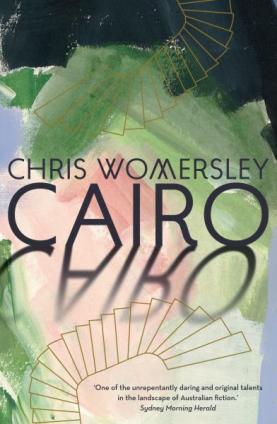
At first I thought Cairo was going to be a pretty standard 'Sophisticated Europe/Provincial Australia' narrative. Louche arty types, whiskied up, railing against their boring, backward country. It's a familiar trope. Germaine Greer stuff - you may have heard of her.
But it's not that at all. It's a pretty standard action drama built around a true crime that took place in Melbourne in 1986 - the heist of Picasso's Weeping Woman from the National Gallery of Victoria.
Womersley has created out of this an absorbing popular tale. It's written with enormous charm and style, without pretension, and peopled with lively characters.
The problem is it falls well short of its literary and imaginative promise. Inspired by an actual event it remains anchored to it, and never has the chance to take off as a more probing, socially critical literary effort.
And it desperately needed a final 'Thirty Years Later' chapter.
Womersley's previous multi-award winning novel Bereft was far more accomplished. But read Cairo nevertheless. It's hugely enjoyable.

This novel is a multiple prize winner and for the life of me I cannot understand why. It won this year's Miles Franklin and the Prime Ministers Award.
It's an empty, meandering failure. I was profoundly irritated by the clotted prose, the passive voice and the constant sloppy use of the wrong word just because it sounded edgy or novel.
It tells the separate stories of two main characters Laura and Ravi. They left me cold, as did the hundreds of other minor characters introduced every second page. The whole thing is a mess. It's a very labored 500 page trawl through these characters' travels and travails. Whatever plot there is lurches forward with grinding tedium. Sure, Australia is sunny, suburban, peaceful, multicultural, but with sad and violent personal histories threaded into its immigrant tapestry. But no larger exploration of meaning is being attempted, at least as far as I could tell.
De Kretser writes like a painter paints - constant dabs of 'there was', 'there were' - adding some descriptive color but not propelling the narrative. Pages and pages are clogged with this sort of impressionistic stuff. Touristy bric-a-brac - a bit of this, a bit of that, all mashed together.
And the ending is entirely predictable - it's Sri Lanka in December 2004. Have a guess!
Two things firstly:
1. I deeply respect the Judeo-Christian tradition, particularly in its Catholic expression. I spent six and a half years in a Catholic seminary including four years in Rome, so I know something about it.
2. I am in favor of gay marriage.
Although the Catholic church will never grant gay marriage equality, it should grant it recognition.
Gay marriage is an issue for the secular state. The church doesn't own the term 'marriage', much less the legal architecture surrounding it.
The official Catholic position is that the sacrament of marriage, in its 'fullness', can by definition only be between a man and a woman, as only such a union is fundamentally 'open' to the pro-creation and nurturing of children. (Concepts such as fullness and openness have a long history in Catholic thought.)
But Catholics can believe in the primacy of heterosexual marriage without resorting to a mindless denigration of gay marriage. In fact surveys show that a majority of Catholics are of that persuasion.
Catholic thinking on homosexuality, like contraception, is still very immature. Orthodox moral theology demonises the 'sin' as ontologically evil, but forgives the 'sinner'. This means the church has a long way to go before it will even come close to embracing gay unions, much less celebrating them liturgically.
But, at a minimum, surely the church can privilege heterosexual marriage as a matter of belief while supporting the state's absolute right to legislate otherwise.
There is no conceptual conflict on other issues of faith and morals like divorce and abortion which the state allows in specific circumstances and Catholic belief doesn't.
Christendom is long gone. We live in a secular, pluralistic, tolerant, multi-faith society, ironically a gift of the Judeo-Christian tradition. It is no longer realistic for Christians to expect, much less demand, that society honour without qualification their particular belief and value system.
Believing in religious freedom also means believing in the legislative freedom of the secular state. The church can organise, protest, lobby and persuade, but it cannot de-legitimise.
Perhaps one day, after an adult church abolishes celibacy and ordains women and the openly gay, it will find itself ready to celebrate and embrace gay unions, thus honouring the deep love and public commitment of the participants.
I'm not one of those who believe this will never happen. The Holy Spirit resides in the people, and the people will eventually have their way.

This is a highly imaginative story of a young teenager, Nao, caught between the two worlds of Japan and California, as she struggles to find meaning in her unhappy life. Her discovery of her 104 year old great-grandmother, a zen monk; her fraught relationship with her depressed, suicidal, father; and, most particularly, her shocking experience of extreme bullying at school - are all described in vivid detail in her diary that seems to have floated across the sea after the tsunami of 2011 to Canada on the other side of the Pacific ocean.
It is found by Ruth, the author, whose reading of it, and some heartrending letters contained in the same package from the monk's WWII soldier son, affects her profoundly.
Did Nao and her father die in the tsunami? This in unanswered, which is disappointing, especially as Ruth finds out independently that Nao graduated from her Tokyo high school and attended Montreal University. Why didn't Ruth follow that up? Perhaps she's still there.
Instead she retreats into recounting a rather fantastical dream, where she meets the father and helps him chose 'life' rather than death. Is it a dream, we are asked to believe, or a parallel world of 'reality'?
So in the end we get frankly ridiculous. It descends into 'Deus ex Machina' territory by inviting us to believe her husband's suggestion that quantum mechanics, with its abstruse theories of 'multiple realities', offers the answer! A real emotional let down.
This is emblematic of the one big structural flaw that lets the novel down in the end - the intrusion of the real life of the author, her husband and her Canadian township into the fictional narrative. This limits Ozeki's imagination as a novelist and reduces the book's power immeasurably. A real pity.
Of the 66 books I've read this year (not including the 10 or so I got nearly halfway through but, due to boredom or annoyance, put aside), these are the ones I found the most satisfying:
Best Novel (Literary):
Howard Jacobsen, Zoo Time. A biting satire of the world of writing and publishing, written with Jacobsen's usual verve and wit. Zingers on every page. Marvellous.
Chad Harbach, The Art of Fielding. I loved this first novel. Don't be put off by the college baseball setting. You'll be turned on by the characters and the plot. At once sad and uplifting. A major achievement.
Martin Amis, Lionel Asbo. Many reviewers thought this pretty ordinary. They're wrong. It's brilliant. They've just gone off Amis, one of our most important writers of the last forty years.
Ian McEwan, Sweet Tooth. Same for this. Universally misread by reviewers. All the men in this beautiful young woman's life are cowardly, duplicitous weasels, and THAT'S THE POINT, IDIOTS! Besides, it's the 70's, and I was fully alive then, and I recognise the truth in it.
Chloe Hooper, The Engagement. How damn good is this? Subtle, nuanced and tantalising right to the end. Amazingly good.
Colm Toibin, The Testament of Mary. Mary considers Jesus a boring little save-the-world dickhead. Wonderful!
Wayne Macauley, The Cook. Extraordinary in every way. So resonant with meaning on multiple levels, and the evil is as exquisite as the food!
Best Novel (Popular):
Hannah Richel, Secrets of the Tides. Despite a seriously bad cover, this is a seriously good book. Families, eh...who'd belong to one?
Dennis Lehane, Live By Night. Raw, tense and just as brilliant as his earlier The Given Day. Ben Affleck has bought the film rights. Can't wait.
Herman Koch, The Dinner. Two brothers - the arrogant politician has the integrity; the progressive lefty teacher is a vicious psychopath. Highly original. Read the final two pages very carefully or you'll miss the whammy, like most reviewers have. Turns everything on its head.
Toni Jordan, Nine Days. What a stunningly good writer Toni is. This is a lovely, heart-warming, rich tapestry of a novel.
Best Crime/Thriller:
Adrian McKinty, The Cold, Cold Ground. Belfast 1981 - a really scary place. A superb, pacy drama with great characters. Can't wait for Adrian's new one out early next year.
Ian Rankin, Standing in Another Man's Grave. Rankin's latest is one of his best, mainly because he resurrects a full-blooded Rebus and ditches the anal Malcolm Fox.
Gillian Flynn, Gone Girl. Brilliantly written, exquisitely plotted. Sucks you in as it unfolds its inexorable, horrible logic. The best thriller I've read in ages.
Best Non-Fiction:
Katherine Boo, Behind the Beautiful Forevers. This extraordinary story about a Mumbai slum puts all your safe, comfortable, healthy, affluent life into sharp relief, you miserable complaining sod!
David Gillespie, Big Fat Lies. Oh I love this guy! The provocative, challenging, amazing Gillespie, who's causing such a stir in the health and nutrition establishment. Just as good as his earlier Sweet Poison.
Laurent Binet, HHhH. You've never read a non-fiction narrative like this. Uses contemporary novelistic conventions to explore an astonishing episode in Nazi history. Playful and charming as buggery, despite its subject matter.
Maxine McKew, Tales from the Political Trenches. Maxine really puts the boot in where it counts. A great political memoir and a thrilling read.
Guy Pearse, Greenwash. As usual Pearse delivers. A well written, thoroughly researched expose of corporate hypocrisy. Stunning.
Paul Krugman, End This Depression Now. If you haven't read any of Nobel prize-winning economist Paul Krugman's writing, then this will introduce you to easily the most important and influential economic thinker of our times. He's such a lucid, elegant writer too. A pleasure to read.
Combine a ludicrously inappropriate marketing campaign (Hachette) - a global embargo a la Harry Potter; no endorsements from respected writers on the cover (that would place it for a reader); a blurb so banal that it misses the whole point - and you get the awful misplaced expectations that have bedevilled the launch of this really excellent, very substantial novel.
This is a gritty, believable story of modern personal and social relationships - husbands/wives; parents/children; middle/lower classes; conservatives/liberals. If the author was not Rowling, but for example, Paul Murray, who wrote the wonderful Skippy Dies (also a story of teenage/adult/social conflict), then there wouldn't be this quite extraordinary squall of snooty dismissiveness and disappointment that has accompanied this novel's release.
It's not hard to describe why quality popular fiction like this works. It successfully creates a world that is totally absorbing. It is rich in believable characters. It has a plot that is complex and satisfying. The interactions between the characters are frequently intense and conflicting. It is gritty, hard-edged and often violent. People get hurt. There is a lot of pain. There is cowardice and courage. There is a totally satisfying, emotionally resonant denouement and resolution.
This describes A Casual Vacancy. It is very good indeed. I enjoyed it immensely.
(This review by Michiko Katukani of the New York Times is worth reading for the vacuous nonsense it truly is. It's typical of a Harry Potter aficionado expecting Mugglemarch to be far more magical and exciting.)

'The wizarding world is the society in which wizards and witches live and interact separate from Muggle (non-wizarding) society. The two communities are kept separate through the use of charms, spells, and secrecy. Wizards are forbidden to reveal anything about magic to Muggle society...' (Wikipedia)
I was reminded of J. K. Rowling's two worlds when reading Alan Hollinghurst's new Booker longlisted novel A Stranger's Child. Only, in Hollinghurst's universe the competing worlds are gay and non-gay.
The gays are the creatives - the poets, the writers, the teachers, the artists, the lovers, the musicians. The non-gays are the plainer, worldly, less interesting domestic, political, academic and business types, usually of inferior sensibility and taste. In the novel the only sex depicted is gay sex. Hetero sex takes place off stage, if any takes place at all. That's left to the reader's imagination.
No-one should have a problem with this necessarily, but as a literary device it's a cliche. And it renders much of the novel simply tedious. There is endless talking between the characters but to little avail. The nature of their close relationships is unexplored. Facts, truth, what actually happened - all remain undisclosed, to the characters themselves and to the reader. This is the 'love that dare not speak its name' after all.
There is much surface glitter, much that is hinted at, much left unsaid. It's a world of secrets and lies, and little enlightenment. But perhaps this is English society, and as an Australian with a plainer tongue, I was profoundly annoyed by it.
I was fully expecting a dramatic ending - a plot development, a detonation, that would bring all the pieces together, that would unify, enrich and give an extra dimension to all the narrative threads that over-populate this story. But none came. It simply fizzled out.
Here is a fairly typical Hollinghurst sentence: 'Dudley turned to her with that unstable mixture of indulgence and polite bewilderment and mocking distaste that she had come to know and dread and furiously resent'.
Firstly, I find it quite hard to picture what sort of look Dudley could possibly have had on his face that could be so described! Secondly, there's apparently a huge amount of emotion going on between these two characters, a husband and wife, that is simply not evident in the rather domestic situation being described. It's just a familiar tizz. They are getting ready to go down to welcome their dinner guests, and she's a bit stressed.
This is the sort of over-writing that Hollinghurst indulges in, and that I find tiresome. There are four 'ands' in the short sentence above. The style is to build the drama, but that's where all the drama is - in the prose, not in the plot. The standard definition of sentimentality is that it's emotion disproportionate to the facts. Here we're seeing a heightened dramatic prose style disproportionate to the routine events, situations and facts it purports to describe.
Hollinghurst describes one of his characters' literary style at one point: 'It was one of his better pre-war poems, though with that tendency to sonorous padding that spoiled almost everything he wrote if judged by the sternest standard.' Hollinghurst could be describing himself.
This is the bookies' favourite for this year's Booker prize. I can't see it winning at all. Most people will find it unreadable and quite unremarkable. And quite insubstantial. That is if they get past the first 100 pages, which they won't.
But, as Bob Ellis would say: 'You may disagree'.
Julian Barnes has had plenty of hits and misses, but The Sense of an Ending is simply wonderful.
It won't win the Booker - it's far too short at 150 pages, and has the feel of a novella - but it's a bright, refreshing tonic of a read, with that knowing, cynical, sharp, socially critical edge typical of Barnes at his best.
Speaking of plot: the book suffers profoundly from a major plot fault. The main character is criticised for not twigging to a critical fact, central to the plot. But, absent a visit from the Archangel Gabriel, he can't reasonably be expected to know it. As a result, we get something quite contrived, closer to melodrama than reality.
But you should buy and read this book if only to indulge in the delicious pleasure of reading the letter the main character writes to his ex-girlfriend and her new lover (who happens to have been a good friend). It's savagery at its best! Withering and marvellous.
And then there's the debate in the cafe about 'hand-cut' chips. They are apparently not hand cut at all. They are 'fat', and machine-made! (Oh, to have been there!)
This one could win it. Sebastian Barry's On Canaan's Side is a superb achievement. Unlike the Hollinghurst and Barnes novels it successfully brings all its elements together into an extremely satisfying whole.
Ironically, these three novels span multi-generational timeframes of youth to old age. We are asked to engage with the main characters and stay with them emotionally during the different phases of their lives. Barry's Lilly Bere, from her earliest days in Dublin, to her final, heartbreaking days in a small village near Chicago, is impossible not to warmly embrace, in fact love.
Of the thirteen novels on the Booker longlist I've only read three so far, but Barry will certainly make the shortlist and become a favourite to win. No doubt.
It's a joy to read.