- Garry Disher's new police procedural once again features Constable Paul Hirschhausen, known as Hirsch, who we met in the superb Bitter Wash Road, published in 2013, which I reviewed at the time and said this:
Bitter Wash Road is Australian crime writer Garry Disher's strongest work to date. It comes pretty close to Peter Temple's classic The Broken Shore in achievement. It's not your average crime thriller. It's a social critique of considerable substance. As well, it has a strong coherent plot, beautifully resolved.
Disher invokes a genuine country Australian atmosphere in all its dry unforgiving hardness. The menace is so thick you could cut it with a knife. We're talking territory not far from Snowtown here - a dark, backward place, where deviance thrives.
- Unfortunately, and much to my disappointment, Peace is nowhere near as good. It lacks power and oomph, and any depth of meaning.
- It has the same country small town setting, the same rural noir deadness and meanness, the same ugliness and provincialism. And the same ugly cops, flown in from Adelaide and Sydney, who hate Hirsch because he was a whistleblower on some significant corruption issues he saw when he was a city detective. He was subsequently demoted, shoved back in uniform and shunted to the country.
- But he is a likeable, competent, caring and highly professional policeman, working hard to keep in touch with his community and its concerns. He navigates and resolves the typical arguments and resentments and is popular.
- A random series of minor crimes is everyday business. But Disher knows how to build tension. You know something big will happen. And it does.
- But in the end the main story loses power and the various threads don’t really mesh in a satisfying way. It sort of fizzes out. Goodies become baddies, baddies become goodies and it's very, well, meh.
- But please read Bitter Wash Road. In contrast to Peace, it's immensely powerful.
- This is a very sober and rather dull read unfortunately because of its decidedly academic tone. But if you are at all interested in the politics and economics of Australia's challenge in dealing effectively with the climate emergency this detailed book is essential reading.
- It’s refreshing and invigorating if you take it slowly and read it carefully. Garnaut's thesis is that Australia has massive potential in a carbon-free future. If we get it right our economy will benefit enormously. - His language is measured and constrained, which I found a little disappointing. He's Australia's authority on this stuff, yet he remains reserved and deliberately refuses to be overtly political. It’s politically anodyne, without anger or passion. He goes way too softly softly. For instance, all he says about Abbott’s destruction of Gillard's highly effective carbon pricing regime, the so-called ‘carbon tax’, is ‘...it left an incoherent climate and energy policy legacy’. Christ, Ross, it was fucking disastrous!
- Nevertheless, as you proceed through the book, you cannot help but be increasingly angry at the Coalition's refusal to face scientific facts and its endless evasions and lies. Labor is not let off scot free either. Adani?
- Resurrecting a carbon tax, by far the best policy, is not possible in the immediate future because it would need to be bi-partisan. But long term? Garnaut remains hopeful.
- I'm so glad I wrestled with this book. It wasn't easy, but I did it. Highly recommended.
- This extraordinary novel is Tsiolkas’ best yet. It's immensely powerful, provocative and utterly compelling. A must read. It may not appeal to everyone however, as Tsiolkas literally grabs your head and bangs it hard against a concrete wall.
- It's a story of the first century of Christianity, focused on the early apostles and believers particularly Saul, later known as Paul. The times are brutal, rough and primitive, and Tsiolkas doesn’t hold back. He paints a world riven with vicious cruelty, lust and misogyny. His prose is vigorous, earthy and masculine, ‘full of blood and life’. The characters are passionate and quick to anger.
- Society is riddled with religious, political and ethnic wars. The Jews hate the Greeks and vice versa, and they both hate the Romans. It’s an ugly world, with its primitive gods, rituals and superstitions. Baby daughters are routinely killed. Regular beatings of women and slaves are the social norm. Tsiolkas thrusts us into the ugliness, vulgarity and depravity of the poor, the slaves and the lower classes; into their trenches of shit and piss and filth - 'the sounds and stink of poverty’. This book is not for the faint hearted.
- Saul, before conversion, despises these new 'Salvation' communities: ‘...they are disciples of that despised teacher, that would-be prophet, that crucified Nazarene crank’. He works for the Jewish priests, hunting dissenters. He’s a spy, and very prone to anger. He detests 'this strange and disturbing cult'.
- Tsiolkas vividly portrays the radical and revolutionary character of the new movement and its adherents, and the searing fractures dividing them. There is no sentimentality here. The Second Coming was believed to be imminent, though as the decades progress, into the fourth generation, doubt is increasing.
- The chapter on Vrasas, a guard and soldier overseeing Paul at the end of his life in a prison in Rome is simply sublime. What a masculine creation he is. Illiterate, bold and stupid, in subservience to his masters and the Roman gods. Like a modern alt-right anti-Semite extremist, brutalism and violence are his defining features. He detests the Christian sect: ‘This is the most depraved of sects, flesh-eaters and lovers of death’. However his summation of his own life-affirming beliefs is compelling:
'I walk with the sun, I walk in the brightness and life of day, I leave the dead to the crows and to the flies. With every breath my blood is nourished by life. Those who pray to death hate this; that we are alive, that we experience joy, that we also suffer and that we know pain; but all of it, the pleasure and the endurance, all of it is worth it, for it is life: all we have is life'.
- Tsiolkas is very theologically literate. This is essential in making the story compelling. For example, the dispute between Jesus’ twin brother, the illiterate and doubting Thomas, and the educated Paul with his deep knowledge of scripture, over what really matters - the physical resurrection of the Saviour or his teachings - is a key early Christian debate. Tsiolkas never shrinks from immersing the reader in these critical theological issues, though of course some readers will be frustrated.
- One real gem is the tussle between Timothy, Paul's long time friend and scribe, and the preacher Able as they face the challenge of motivating a congregation of believers to 'await the Saviour’s return'. Able is a populist evangelist, and Timothy more conservative and intellectual. The issue is: should we 'remake the world’ or ‘turn the other cheek and retreat from the world’. The believers are divided too - the citizens and the refugees. The refugees abhor the ‘turn the other cheek’ message. They are now proud ‘Christians’. The scene reeks of a Hillsong, modern day Pentecostal assembly.
- There are so many more arguments, debates and issues explored in this extraordinary novel. It is formidable in its scope and ambition. Having being frustrated over recent months with new fiction - so many books started but then put aside - I absolutely devoured this. It was what I was craving. It restored my faith in the power of literary fiction.
- It will undoubtedly dominate the literary awards calendar next year, and be a Booker contender as well.
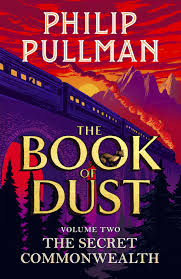
- Philip Pullman's second volume in The Book of Dust trilogy is a delightful read. It's just lovely to be re-introduced to Lyra and Malcolm again. It's nineteen or so years later. Lyra is 20 years old now and Malcolm 32. She's a student and he's a professor of history at Oxford.
- The series continues the story of Lyra from Pullman's earlier His Dark Materials trilogy. Both are set in a parallel world, modern, yet non-modern, pre-internet times.
- The Secret Commonwealth, as explained by Lyra, refers 'to the world of half-seen things and half-heard whispers. To things that are regarded by clever people as superstition. To fairies. Spirits, hauntings, things of the night'.
- Lyra and her daemon Pantalaimon are estranged due to their separation by a witch in the calamitous Arctic wars a decade previously. The human/daemon relationship is explained in more detail in this book. It seems more like friendship and companionship. There are far more conversations, more sharing. Individual humans are frequently referred to as ‘they’ - the human and the inseparable daemon.
- In this volume Pullman's focus - thankfully - is far more on the real, human, political world. There are no fairies, witches, aeronauts, armoured bears or battles, and less freakish, cosmic strangeness. The story of Lyra and Malcolm, and the way Pullman slowly develops their increasingly romantic connection, is powerfully engaging.
- The central storyline is that the ultra conservative, ecclesiastical and authoritarian Magisterium is regrouping. After centuries without papal leadership ambitious men want back total control. This is forcing the Oakley Street organisation (reformists) to re-organise too. Things are also stirring in the distant Levant. The precious resource, rose oil, is becoming scarce and expensive.
- Lyra’s personal struggles as a young woman are front and centre as well. She is grappling with the contrasting notions of reason and imagination. She’s reading books by faddish 'rationalists', and her daemon Pan objects. He demands she rediscover her imagination. One night he deserts her, setting off on his own journey. Lyra simply must follow and search for him. She longs for reconciliation.
- I have one major difficulty with Pullman's trilogies. He can’t help himself at times. He continually introduces strange characters who have only a tangential relationship with the overall plot, like the 'Furnace-Man' and the 'Princess Cantacuzino'. Yet on the positive side, these novels being essentially stories of journeys and adventures, many characters Lyra meets are good natured and kind and offer her names of friends and associates to connect with.
-
I really look forward to the final novel in this trilogy. So much will be resolved I'm sure. And in a very satisfactory way. Pullman is a genius.
- McEwan’s always been a master storyteller and his skill is again on show here. He’s also politically astute.
- Unfortunately though, this 100 page novel is in the end a dismal failure. The Kafka-inspired cockroach side of the story is just silly. It's too simple, obvious and literal to be effective satire.
- Jim Sams, the newly installed British PM (Boris obviously), and Brexit feature. Sams applies all his cunning and deceitfulness to get Brexit through parliament (although here it’s called ‘Reversalism’, as compared to our current 'Clockwise' economies). Reversalism turns everything upside down. Citizens pay money to work, and get cash payments from the government when they spend. Companies pay money when they export and receive money when they import.
- It's a truly absurd and ridiculous thesis which has no satirical oomph because it completely misconstrues Brexit and the disruption it would involve.
- There are of course some lovely moments. This is McEwan after all. He captures perfectly the deviousness, treachery and cunning of ruthless politicians - the Cabinet meetings, the press leakages, the constructed fake news, the anti-PM plotters, and others.
-There is also coruscating wit at every turn as he caricatures the dismal, elitist, Conservative Cabinet members - the cockroaches.
- This novel could have been heaps better had McEwan not strayed so far from Boris and Brexit realities.
- This novel is the final in Coetzee's magnificent Jesus trilogy - The Childhood of Jesus, The Schooldays of Jesus, and The Death of Jesus. In my opinion it's the best of the three.
- It shares the formal prose style of the previous two, reading like an Elizabethan drama, and investing the story with a level of fabulism akin to the gospel story of Jesus of Nazareth. The boy David is an otherworldly creature and his story full of parables.
- In this final novel David is only ten years old but he 'cannot or will not do sums. More worryingly, he will not read’. He only reads Cervante's classic novel Don Quixote, and is obsessed with the comic idealist's opposition to anything real. The central theme is idealism versus reality. Quixote’s idealism promises liberation. As his followers cry ‘liberate us from our wretched fate...make our chains fall away’.
- Likewise, David has a mind of his own, undeveloped as it is. He's over-confident, even arrogant. He’s an ‘extravagante’ according to his teacher, and a gifted dancer.
- Simon and Ines are his foster parents who took him in five years previously and love him deeply. However a local orphanage and its soccer team holds an attraction for David that he can't resist. He wants to live there. So he makes an accusation against Simon, who's been ‘...doing bad things to me’.
- The relationship between Simon and Ines is a more central focus of this book than David, and is very well presented. They are caring, loving people, flummoxed by David’s new sense of independence. They argue, of course, but in the end their frustrations with David's eccentricities invest this novel with real power. When he suddenly becomes quite ill and is confined to hospital, the leaden, bureaucratic protocols of the hospital put enormous strain on them. In the end David dies of the mysterious, undiagnosed illness, and Simon and Ines continue to be treated disrespectfully by the hospital staff because 'there are rules we have to follow'.
- In all three books in the series Coetzee makes no specific Christian references. Apart from the titles there is no Jesus, heaven, hell, miracles, or even Mary and Joseph. It’s a secular world. However Ines and Simon are clearly Mary and Joseph, ‘companeros’, not husband and wife or in any sexual union. The novel explores their relationship. They are just human beings. The Christian gospels, on the other hand, never present them as such. And Jesus was fully human too, no doubt as annoying as David. So Coetzee is essentially demystifying the biblical story, removing its supernatural embellishments. After David's death was there a resurrection of sorts? No, just memories.
- But Simon does say at one point: ‘The world may be as it was before, but it is also different’. And his former dance teacher says: ‘You could learn only by following. When David danced he was somewhere else, and if you were able to follow him you would be transported to that place too’.
- The peculiar Dimitri character, so central to the second book, is a key player in this one too. He's a passionate 'follower' of David. After David's death he writes long letters to Simon, who he considers 'ordinary'. What are we to make of these letters? They smack of devotion but also of madness. While Simon and Ines go their separate ways, into normal lives, is Dimitri, an unabashed enthusiast, soon to become a gospel writer?
- ‘I mightn’t have done much good in my life, but at least I contributed to the destruction of the planet.’
- The unfortunately christened Florent-Claude Labrouste is 46 years old and a typical Houellebecq sad fuck. Cynical, disillusioned and alone. The sort of bloke that hates Paris and hates pensioners. He's wonderful company - intelligent and exceptionally well-informed, and he’s confiding in YOU.
- In the typical Houellebecq way, literary references are sprinkled throughout, mostly cheekily. And very satisfyingly there's so much wisdom:
'...there can't be an area of human activity as utterly boring as the law'.
'...our student years are the only happy ones, when the future seems open, when everything seems possible, and after that adulthood and a career are only a slow and progressive process of ending up in a rut'.
‘...alcohol is very important for the elderly, it’s almost all they’ve got left’.
‘God is a mediocre scriptwriter...the whole of his creation bears the stamp of approximation and failure, when it isn’t meanness pure and simple’.
- He studied agriculture and started working initially at the giant corporate Monsanto, and hated it. ‘My superiors in the company were quite simply pathological liars’. Now he’s working for the Department of Agriculture and negotiating with Brussels.
- As part of his job he travels a lot, all over France it seems, and drops names of streets, provinces, villages and locales, and this is rather challenging. I had to continually call on Google maps to follow his journeys.
- Of course there's lots of sex. In fact, there's an obsessional focus on it as he reflects on his former girlfriends and lovers. But it’s very funny too, as if sex is a type of comedy routine carried out by two people, or one woman and a dog or two. This time he's far more comic than in any of his previous novels, which adds to its delight. The thing is though, he rarely makes love, just seems to get blowjobs. It’s all about his cock. Ironically, however, his new anti-depression medication makes it well nigh impossible for him to get an erection.
- Houellebecq is a very political novelist and this novel is no exception. Florent-Claude's good friend and fellow agriculture student began working for Danone on graduation, and later bought a farm, raising dairy cows in the very local, traditional way. But Brussels’ decisions would bankrupt him and millions of French stockbreeders. The EU and its free trade policies were devastating. The Chinese were also buying traditional farm lands. The local farmers started organising and protesting, some with guns. It all ended tragically, with countless suicides.
- In the end he's fading away, sadness overwhelming him. But he offers us deep and rewarding reflections on Thomas Mann, Marcel Proust, and Arthur Conan Doyle.
- And in a passage of exquisitely beautiful prose, he describes his simple joy on listening to a bootleg recording of the rock band Deep Purple in concert in Duisburg in 1970.
- Reading Houellebecq is always a pleasure, and Serotonin is absolutely no exception.